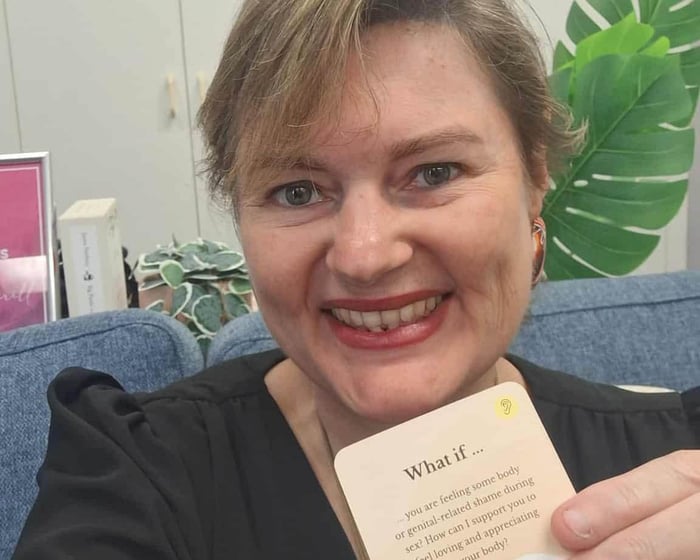
Scenario Cards Case Study: Parent Trust

In this case study, we explore how Scenario Cards helped Anne, a teacher and coach in Switzerland, break through the silence to build lasting trust with her teenage daughter.
How to Reach the Unreachable
Raising a teenager can feel like walking a tightrope while hovering above a pit of snakes. You want to protect, yet you need to give them space. You long to connect, yet you hit walls when you try.
Anne knows this more than most. She works as a teacher and a coach at a school in Switzerland, where she supports teenagers. At home, she also faced many challenges with her own teenage daughter.
“She’s a teenager, and on top of that, she’s going through transition. There’s a lot that’s not said, there’s a lot of new stuff,” says Anne.
Bridging the Gaps of Adolescence
Anne is no stranger to guiding others through life’s turning points. But supporting others professionally doesn’t always translate into ease within the family. Both at work as a teacher and at home as a mother, Anne felt the same subtle tension: the conversations that mattered most were often the hardest to initiate.
Then, the right tool came at the right time. Scrolling Instagram one evening, Anne came across Scenario Cards’ Purpose and Growing Up collections.
“I wanted to look for something different that wasn’t the usual coaching model,” she recalls.
The Scenario Cards felt fresh, short, simple, and divided into categories that could open doors in unexpected ways. They were not like the books or standard frameworks she had leaned on before.
When the cards arrived, Anne placed them around the house alongside her usual quotes and notes. Her daughter noticed it right away.
Accustomed to finding little cards scattered through the home, she asked one evening, “What are those?” Anne handed them over with a smile. “Have a look. I just bought them.”
How One Question Helped Her Support Her Daughter
What began as flipping through a few cards stretched into an entire evening. They asked each other question after question, laughing at some, pausing with others, and finding themselves caught in a flow that lasted hours.
Soon, they began crafting regular evenings of connection. They’d light a candle, get out the Scenario cards, and see where the conversation would lead.
One evening, they stumbled upon a card that changed their relationship forever. The question read, “What if you could travel back to before your birth and have a talk with your parents? What would you like them to know?”. Her daughter’s answers stopped her in her tracks.
“The answer was quite strong and quite upsetting,” Anne admits. “But it opened a conversation that needed to happen because I understood how she really felt. And although we’re quite close, being a teenager is so complicated in itself. It has so many challenges, and sometimes it’s difficult to communicate even with people you’re comfortable with.”
That difficult moment became a turning point for both of them.
“That card opened up so many conversations, and I was able to put the right support in place because of that question and answer. I believe it made a huge difference,” says Anne.

Showing Up for Friends in Meaningful Ways
Anne often supports her friends, but this can feel more complicated than working with students since it was harder to detach from their emotional process. Scenario Cards help her create distance. Acting like a neutral “third voice,” they allow her to stay present without becoming overly involved, and give her friends the perspective they need to see their situations more clearly.
“One of my close friends was going through a difficult time in her relationship,” Anne recalls.
“We talked a little, then I said, ‘Do you want to try something different?’ We pulled a few cards and went through the questions together. It guided the conversation in a way that gave her clarity. She left not just feeling lighter, but with one concrete thing she wanted to change in herself and in her relationship.”
For Anne, the beauty of Scenario Cards lies in how they shift the dynamic of a conversation. Instead of ending in a simple vent that brings only temporary catharsis, the cards invite a deeper kind of introspection. They create clarity around what matters most and often highlight a next step to take or an idea to reflect on. This mirrors the kind of forward movement Anne values in her coaching work.
“When you just talk with friends, you often unload and feel better, but you do not always leave with a solution. The cards bring focus. They help you walk away with something to actually try.“
Helping Students Share What’s Really On Their Minds
Whether with her daughter, her friends, or her students, a common thread runs through Anne’s story: creativity and a willingness to meet people where they are. With her daughter, that once meant packing the cards for a family trip to France, where one evening they laughed their way through an entire deck in a single sitting.
At school, where she works with kids aged 14-17, her creativity shines in the way she makes it easy for them to engage.
“I use them when we go for a walk,” she says. “I’ll put a card on a bench or even in a tree, and then point and go, ‘Oh, what’s that?’"
In this way, the cards serve as a playful surprise that helps students ease into difficult conversations. After all, if it is just a pretty-looking card tucked into a tree, how intimidating can it really be?
Conversations Worth Having
Not every parent, friend, or teacher knows what to say when the silence feels heavy. Anne reminds us that you do not always need the perfect words; in fact, sometimes you do not need to ask questions at all. Sometimes all you need is a neutral voice, a gentle guide that invites honesty without pressure.
“It’s a good way to have conversations, and it’s fun. It’s just a different way, especially today with cell phones when we forget that we need to talk to each other.”
Her vision stretches far beyond the classroom and the living room. “I could see them in a museum or an art gallery, even in a retirement home, to spark reflection. Schools, waiting rooms, cafés, anywhere people gather or wait. Even if you’re just thinking about the answer yourself.”
To those considering picking up a deck, her advice is simple: preview the questions, be ready to rephrase when needed, and above all, give it a try.
“Definitely go for it,” she encourages. “It’s original. It’s not a book. Not an activity that is already out there. It’s something new that people will connect with.”
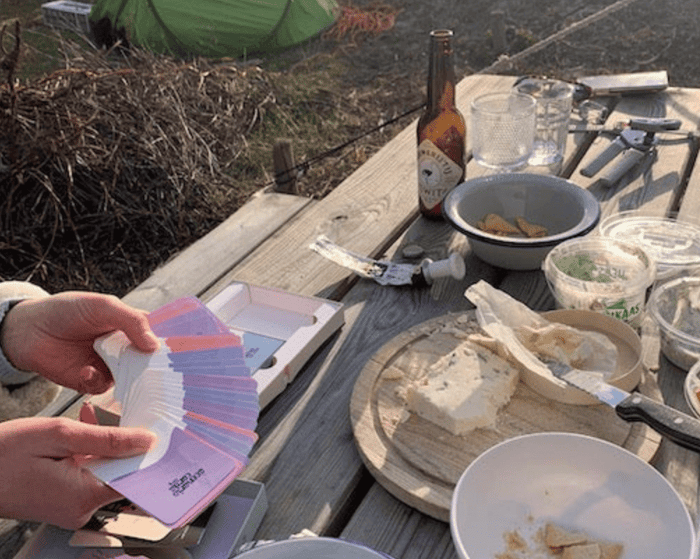 Playing Scenario Cards in the Suisse Alps
Rewriting the Teenage Years With Love
The teenage years can be some of the hardest ones to navigate. Without awareness and intentional conversations, many young people grow into adults carrying silent resentments and wounds that were never tended to.
The stakes could not be higher. In the United States, more than one in five high school students seriously considered attempting suicide in the past year, and nearly one in ten made an attempt. This is a stark reminder of how much teenagers need consistent emotional support and safe spaces to share what they are going through.
Anne is paving a new path, one that actually works. By leaning into better questions, she continues to give her daughter space to be heard and the chance to feel truly understood. Their evenings with Scenario Cards are not a one-time breakthrough but an ongoing practice that breeds trust, laughter, and openness.
Her story is a reminder that all humans, teenagers included, can open up and process their emotions, so long as they are met where they are.
Anne may be paving the way, but other parents can easily follow this path too. And while teenagers may rebel against authority, it is a lot harder to rebel against a beautifully designed question printed on a card.
Meet Them Where They Are
As Anne discovered in the mountains of Switzerland, you don’t need to be a perfect parent or an expert coach to reach a teenager, you just need to give them a safe place to land. Whether you're lighting a candle for a quiet evening at home or tucking a card into a tree for a student to find, you are building a foundation of trust that can last a lifetime.
Don't wait for the silence to get heavier. Explore our collections and follow Anne’s lead: put down the cell phones, pick up a deck, and start rewriting your relationship with the young people in your life, one "What If" at a time.